Windproof& Breathable:
The Technical Logics Behind Performance Claims
Published September 17, 2026
## Summary
Windproofing and breathability are two requirements that come up again and again in the specs of outdoor brands — today we're breaking down the technical logic behind each one. Windproofing comes down mainly to fabric density and post-treatment. In principle, a denser, tighter construction improves windproofing, but that same density also restricts the pathways air needs to pass through the fabric — this is the fundamental, long-standing trade-off between windproofing and breathability.The hardest part of sourcing functional fabrics usually isn't not only finding a supplier — it's the gap in what "meeting spec" means to different markets. Buyers ask similar-sounding questions (breathability, water resistance, durability), but the testing logic, application scenario behind those questions are so different. Whether the factory location and capacity match audit requirements, whether breathability and UV figures are backed by third-party reports, whether durability testing covers enough wash cycles , whether water-repellency was tested after line-drying or tumble-drying, and how customization requests ripple into performance changes .Each is broken down below.
Breathability itself can actually be broken down further into two distinct physical mechanisms that are often confused or used interchangeably: air permeability, which is air passing directly through the fabric, and moisture vapor transmission, which is water vapor molecules passing through.
Below we break down both of these in order: how the VERSWIND® line approaches windproofing differently depending on application, tiering products by degree of wind resistance; and the common confusion between "air permeability" and "moisture vapor transmission" within the broader term "breathability."
---
## Main Content
### Windproof: How the VERSWIND® Line Builds Different Windproof Logics for Different Use Cases
Windproofing is fundamentally about "blocking air from passing directly through the fabric surface." There are broadly three approaches: weaving the fabric dense enough that the structure itself provides a physical barrier; post-treatment such as coating or micro-porous membrane lamination that closes up an otherwise air-permeable weave; and an intermediate surface treatment such as cire.
The core VERSWIND® line is built for down-proof, breathable shell fabric, with air permeability controlled to a very low range (<1cc, roughly 1.9 cfm). At this spec range, the windproofing logic has to balance two things at once — keeping down feathers from poking through, and avoiding a clammy, non-breathable hand feel. That balance requires more careful control of weave density and post-treatment than a typical windproof product, usually calling for high-count, fine-denier yarn woven at high density (generally toward the higher end of the warp/weft density range) and C0 DWR (durable water repellent) finish can be added depending on the style.
VERSWIND® Lite is built around high-intensity athletic stretch, with air permeability raised to 2–15 cfm. The windproofing here is deliberately relaxed — the trade-off is giving up some wind resistance in exchange for breathability and comfort during high-output activity.
Four-way stretch also requires the weave itself to retain some looseness; it can't be woven too tightly. These fabrics are usually paired with elastane to maintain recovery.
VERSWIND® Mx is built for all-weather use, where windproofing and waterproofing rely primarily on a PU Micro-porous coating rather than fabric density alone. In this case, weave density isn't the sole determining factor — windproof performance is driven more by coating quality, membrane thickness, and layer count, with the base fabric serving mainly as a substrate. These constructions are typically finished with a DWR treatment on the face fabric as well, so water beads and rolls off the surface first, reducing the long-term saturation load on the membrane.
In short, "windproof" means three different things depending on the construction: down-proof shells rely on weave density, athletic stretch styles trade off windproofing for breathability, and all-weather styles rely on coating or lamination. These three logics aren't interchangeable — sourcing decisions should start by confirming which application scenario the customer actually needs.
There's also a middle-ground approach between "dense weave" and "coating/membrane lamination": cire. This process uses heated, high-pressure rollers to flatten and compress the fiber surface, closing up the gaps between yarns and improving windproof performance without adding a laminated membrane. Weight gain is minimal, and it's commonly used for mid-tier styles that don't need to hit all-weather-grade performance but still want better wind resistance than a basic weave provides.
The downsides of cire are threefold. First, the effect loosens gradually with repeated washing — durability that typically doesn't hold past a handful of wash cycles — whereas VERSWIND maintains its windproof performance through more than 20 washes. Second, cire compresses the fabric's surface pores to achieve windproofing, which also seals off the pathways air needs to pass through, resulting in very poor breathability; VERSWIND, by contrast, is engineered to preserve airflow even while blocking wind. Third, the mechanical compression involved in cire eliminates stretch entirely, while VERSWIND maintains stretch across all three of its product tiers.
Air permeability data is commonly tested using the Frazier method (corresponding to ASTM D737 or JIS L1096); European buyers also frequently reference ISO 9237. Values are commonly expressed in cfm, mm/s, or L/m²/s — which is why VERSWIND® spec sheets list cfm ranges directly. When reviewing a test report, buyers should first confirm the test method used, since different methods apply different pressure differentials and the resulting numbers aren't directly comparable. When converting between units, always ask the lab for the original test conditions rather than relying on a single converted figure.
### Breathability: How P&E incorporate Leno/Gauze Weaves with Polypropyleneead time and production capacity
Breathability has 2 different meanings: air permeability and water vapor permeability as mentioned earlier. Air permeability measures how easily air passes directly through the physical openings of a fabric. It is strongly influenced by factors such as weave or knit density, yarn construction, and fabric structure. For example, Leno/Gauze construction creates visible open pores by twisting pairs of warp yarns around the weft, allowing substantial airflow while maintaining greater structural stability than simply reducing weave density. Common air permeability standards include ASTM D737, JIS L1096, and ISO 9237. Airflow results can also be interpreted against a defined reference; for example, 98 cfm compared with a reference of 1,970 cfm represents approximately 5% relative air permeability (98/1,970), or 95% resistance to airflow.In response to changing market demands, suppliers need to be able to meet the brand’s required delivery schedule. Therefore, lead time and production capacity are important factors when evaluating a supplier. It is important to understand not only whether the supplier has sufficient capacity to handle the required volume, but also whether its lead time can meet the brand’s timeline.
P&E has endeavoured to use both concepts in different ways.
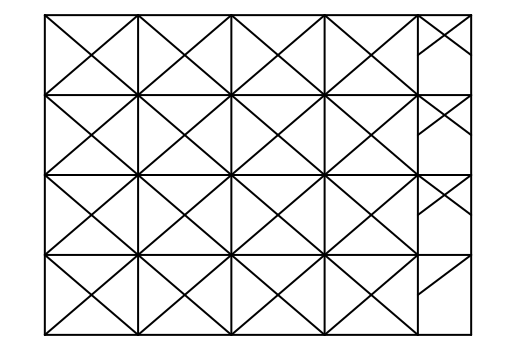
Leno (also called gauze) is a somewhat specialized approach to breathability in performance fabrics.
The principle is that pairs of warp yarns twist around each other, locking the weft yarn at each crossing point. The resulting fabric has visible open pores, but the structure itself is comparatively stable and less prone to yarn slippage despite the larger openings. This differs from simply lowering weave density to gain breathability — reducing density also increases air permeability. Leno/Gauze construction is a way of balancing "openness" against "structural stability. P&E has utilized this structure to combine with polypropylene creating the most breathable and quick dry fabric.
### Moisture Vapor Transmission
MVTR, on the other hand, measures the amount of water vapor that passes through a material over a given period and does not depend on direct airflow through physical openings. P&E also develops fabrics with hydrophilic membranes, where moisture vapor is absorbed by hydrophilic polymer segments and transported through the membrane by molecular diffusion before being released to the outer side. This allows a fabric to restrict airflow while still transferring moisture vapor away from the body. Common MVTR standards include ASTM E96 and JIS L1099, using methods such as upright or inverted cup configurations.
In other words, a fabric can have low air permeability while still maintaining good moisture vapor transmission, an important combination for waterproof shells that need to block wind and rain while allowing sweat vapor to escape. Therefore, when a customer requests “breathability,” it is important to confirm whether air permeability or MVTR is actually required. If waterproof performance is also concerned, hydrostatic head, commonly tested according to ISO 811 or AATCC 127, should be evaluated separately as a third independent performance indicator.
---
## Decision Reference Table


## Contact Us
If you're evaluating fabric specs for windproofing, breathability, or abrasion resistance, we recommend first confirming the actual application scenario (down-proof, athletic stretch, all-weather, or localized breathability/abrasion-reinforcement zones) along with which version of the test standard is required. We can recommend the appropriate weave structure and yarn combination based on your needs, and help verify that spec reports across suppliers are using consistent test methods.👉 [Contact Us](https://www.petextile.com.tw/contact)

UPF50+
Blocks 98% of UV rays — protection built
into every thread. No sunscreen needed.
Whether you're hiking, cycling, or spending
the day at the beach, you're covered.
Fishing Net
Discarded fishing nets don't belong on the
ocean floor. Recycled and reimagined
through InResST®, they become the shirt
on your back — cutting 91% of CO₂ emissions
with every piece. Wearing it is the action."